Nobody's Home: How Dead-Internet Thinking Became the Default Way We Read the Web
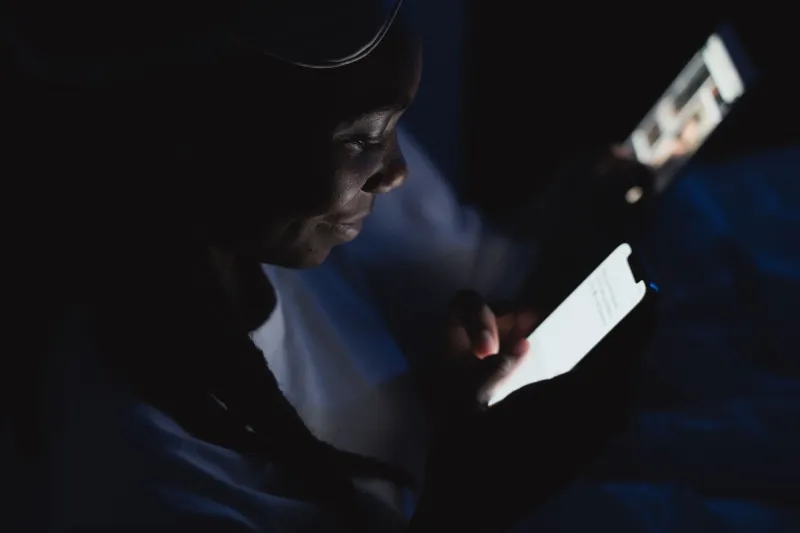
Renee is 29, lives in Columbus, Ohio, and processes insurance claims for a living. She is not, by her own account, a conspiracy person. She does not believe the moon is a hologram or that birds are surveillance drones. But somewhere in the last year she stopped assuming the person on the other end of a Hinge match was a human being.
"If the first three messages are too smooth, I'm out," she told me. "If they ask me a question that feels like a prompt, I'm out. If they send a paragraph, I'm out." She laughed, then didn't. "Most of my matches are out."
That reflex — that small, automatic suspicion — is the subject of this piece. Not because Renee is paranoid, but because she isn't.
A bit that stopped being a bit
The dead internet theory has an unusually traceable origin. A poster on the Agora Road's Macintosh Cafe forum, writing under the handle IlluminatiPirate, laid it out in 2016: the internet as we knew it had already died, sometime around 2016 or 2017, and what we were browsing afterward was a hollow shell of algorithmic feeds and automated accounts mimicking human culture. For years it was a joke with a haunted-house energy — funny in the way that a well-aimed creepypasta is funny.
Then the joke started getting footnotes. In 2025, Cloudflare reported that automated traffic had, for the first time, edged past human traffic across its network. That is not the same thing as "the internet is fake," but it is also not nothing. Bot traffic has been climbing for a decade; anyone who has run a small website knows the comment sections fill with nonsense from Eastern European IP ranges before a single real reader shows up.
What changed in 2026 isn't the number of bots. It's that the theory left the forum and moved into the group chat. It's now the lens a lot of people use to read everything.
Slop did the recruiting
Generative models made the theory self-evident. You don't need a conspiracy when your aunt's Facebook feed is full of AI-generated images of veterans hugging flags, when the top Google result for a recipe is a hallucinated blog with no author and a photo of a chicken with too many fingers, when the YouTube video you fell asleep to features a synthetic voice narrating a Reddit thread that a different AI wrote.
The slop is not fringe. It is the ambient weather of the American internet. Walmart listings, podcast ads, Amazon product descriptions, the LinkedIn post your old coworker definitely did not write himself. Once the web is majority filler, "is this real" stops being a philosophical question and becomes a daily chore, like checking a parking meter.
Your neighborhood Facebook group is now a case study
Here's where it gets local and strange. In the Buy Nothing and neighborhood groups that still anchor a lot of suburban American life, moderators now spend their evenings doing verification work that would have sounded insane in 2019: asking new members for a photo of a handwritten note, cross-checking profile creation dates, explaining for the ninth time that the adorable lost-dog post is a scraped photo from a 2014 shelter listing.
"We had a guy claiming to be a neighbor for six months," a moderator in a Twin Cities suburb told me. "Perfect English, knew the street names, never once showed up to anything. Turned out to be farming engagement for a page that later pivoted to selling crypto. Now if you don't come to a park meetup, you don't get to post."
The deliberately un-scalable solution is the tell. The only verification that still works is a body in a park, holding a coffee.
The review economy is a hall of mirrors
The place this hurts most, quietly, is commerce. Americans still read reviews before they spend money, and reviews have become the least reliable text on the internet. Yelp and Google listings get seeded by LLM-written praise. Amazon's ratings are a swamp of incentivized noise and refund-baiting. So people do what Renee does: they go to Reddit for the honest answer — and Reddit threads are now themselves partially farmed, summarized, and reposted by bots.
The trust chain ends by bottoming out. There is no last honest page. There's just the point where you decide you've done enough.
'You're a bot' is the new 'you're a shill'
The political version is uglier. Bot amplification is real and well-documented; coordinated networks push narratives on every major platform. But the bot accusation has also become a way to delete people. In 2026, the reflexive "this account is a bot" is applied with startling speed to organizers, trans users, disabled users, anyone whose posting cadence doesn't look like the median. The dead-internet frame is a very convenient excuse for dismissing a real person who is inconvenient.
That's the asymmetry nobody likes to sit with: the theory is directionally correct and still functions as a weapon. Both things are true at once.
The relief is the scary part
What worries me isn't that people believe the web is full of bots. It's the small exhale that follows. If nobody's real, nothing is owed. If the outrage is scripted, you don't have to feel it. If the person asking for help is a scam, you can scroll past with a clean conscience.
That is a very comfortable place to end up, and it is exactly where the people building the slop want you.
Renee is still on Hinge. She's also started going to a Sunday run club, where the verification is a handshake and a shared mile and the person next to you is out of breath in a way that would be very expensive to fake. She says it's the only place online-adjacent she doesn't feel like she's being farmed.
She isn't wrong about the internet. But the answer to "nobody's home" has always been the same: knock on an actual door.